How to Improve Your Warehouse Management System: 7 Practical Fixes

Quick answer
Improve a warehouse management system (WMS) in this order:
- Measure performance against published benchmarks.
- Clean item and inventory data.
- Re-slot inventory and rebalance labor.
- Replace custom code with configuration.
- Connect systems through a reusable integration layer.
- Test for peak volume and every release.
- Put managed support behind the live system.
In Everest's view, replace the platform only when it blocks growth, automation, or vendor support.
At a glance
-
76%
of supply chain and logistics leaders surveyed report notable workforce shortages, and 56% report shortages in warehouse operations.
Descartes, 2024
-
58%
of those respondents say workforce shortages have hurt service levels.
Descartes, 2024
-
99.68%+
is best-in-class order-picking accuracy, and best-in-class on-time shipments are 99.5% or higher.
WERC, 2025 DC Measures Report
-
Half
of new warehouses in developed markets will be designed as human-optional facilities by 2030.
Gartner, 2026
Everest's view: most of the work sits in data, configuration, integration, and testing before it sits in new software.
Why Improving Your Current WMS Matters Now
Three pressures are pushing operators to get more from the WMS they already run:
-
Labor is tight.
The Descartes survey covered 1,000 decision-makers in the U.S., Canada, and nine European countries.
-
Service levels are exposed.
More than half of those respondents link shortages to weaker service.
-
Automation is coming.
Gartner describes these human-optional facilities as robot-centric. A WMS built for people-only workflows will need to coordinate equipment as well.
Before changing anything, decide whether the system needs tuning or replacing.
Defining the Terms
- Warehouse management system (WMS)
- Software that directs how inventory is received, stored, picked, and shipped in a distribution center (DC).
- WMS optimization
- Improving how an existing WMS performs through data, configuration, integration, testing, and support, without replacing the platform.
- Warehouse execution system (WES) and warehouse control system (WCS)
- A WES coordinates work across the WMS, labor, and automation. A WCS directs automated equipment in real time.
- Material handling equipment (MHE)
- Conveyors, sorters, robots, and similar equipment.
Optimize or Replace? A Quick Check
This table is Everest's working checklist, not an industry standard.
Optimize or replace: what each signal points toward
| What you see | Points toward | First step |
|---|---|---|
| KPIs below benchmark, vendor still supports your version | Optimize | Baseline, then fix data, slotting, and configuration |
| Heavy core customization | Optimize first, then reassess | Inventory every modification |
| Integrations rebuilt for each new system | Optimize | Move to a reusable integration layer |
| Platform cannot connect to planned automation or new sites | Replace or modernize | Run an assessment |
| Version nearing end of support | Plan a migration | Check the support policy for your exact version |
If several rows point to replacement
Otherwise
The seven fixes below are the place to start.
7 Practical Fixes for Your Warehouse Management System
Work through these in order. Each fix makes the next one easier to measure.

1. Baseline performance against published benchmarks
- Pull a full year of data for on-time shipments, order-picking accuracy, inventory count accuracy by location, dock-to-stock cycle time, and capacity used.
- Compare each against WERC's 2025 DC Measures. Best-in-class order-picking accuracy (by order) is 99.68% or higher. Best-in-class on-time shipments are 99.5% or higher.
- Split results by DC, shift, and customer type to see where the gap sits.
- Record the baseline. Every later fix needs a before-and-after number.

Everest note: The assessment phase starts with visits to flagship DCs to find pain points and redundancies.
2. Clean up item, location, and inventory data
- Check item dimensions, weights, units of measure, and packaging. Cartonization, slotting, and capacity planning all depend on them.
- Name one system of record for each data field, and one owner for changes.
- Fix errors at the source before adjusting counts in the WMS.
- Track inventory count accuracy by location as a standing KPI.
3. Re-slot inventory and rebalance labor
- Re-slot by current demand, not last year's layout.
- Review labor standards and task assignment through labor management.
- Watch capacity used. WERC's best-in-class marks are 90% or higher on average and 100% or higher at peak, because WERC counts a building that runs full, or over capacity, at peak as efficient use of space.
- With 56% of respondents reporting warehouse labor shortages (Descartes, 2024), every wasted step matters more.
4. Replace custom code with configuration and update-safe extensions
- List every modification: what it does, why it exists, and whether the base product now covers it.
- Retire what the platform handles natively.
- Rebuild what is truly unique as extensions on the platform's own framework.
Manhattan SCALE and WMOS
Extensions are typically customizations to the core that must be retested at each upgrade.
Manhattan Active®
Built so version updates apply without re-implementation, though extensions should still be regression-tested each quarterly release.
Know the difference before you rebuild anything. Source: Everest Technologies.
5. Connect the WMS to everything around it
- Map every link: ERP, order management, transportation, labor, and automation.
- Move point-to-point links onto a reusable integration layer. Everest builds these with MuleSoft, Boomi, and Kafka.
- Monitor latency and failures. A slow integration can look like a slow WMS.
- Synchronize WMS logic with MHE so equipment follows the same task sequencing. For heavily automated sites, check whether a WES or WCS is needed. See Supply Chain Strategy with Automation and How Much Autonomy Should an AI Agent Have in Your Warehouse?

6. Test for peak and test every release
- Test the full workload at once, including integrations and automation, at peak volume.
- Automate regression tests so every release is checked the same way. Everest builds these frameworks.
- Keep a production-like test environment.
- Schedule changes away from peak.
Everest note: Testing covers functional, integration, end-to-end, user acceptance, and performance work, including load testing for peak volumes and warehouse automation.
7. Run the WMS as a managed service after go-live
- Set service levels for response and resolution.
- Trace incidents to root cause instead of repeating repairs.
- Review KPIs against the baseline on a fixed schedule.
- Keep release management and monitoring in one accountable team.
Everest note: SLA-backed L2 and L3 support, production monitoring, incident and release management, and continuous optimization are available for Manhattan Active® environments. Everest also supports Manhattan SCALE, WMOS, Infios, and Made4Net, so one team can cover more than one platform.
These fixes cover tuning. The examples below show tuning first, then what is possible when the platform itself is the constraint.
What Improvement Looks Like in Practice
The first engagement tuned an ActiveWarehouse™ operation through configuration alone. The other three modernized or replaced a legacy platform.
Regional grocery retailer
- Multi-DC network
- Configuration only
Starting point
Heavy meat items were landing on top of lighter products during pallet building, and the legacy system could not enforce cubic threshold rules, so pallets were unstable.
What Everest did
Tuned picking and pallet building with standard ActiveWarehouse™ features, Residual Cubing Constraint and Pick Location Sequence Configuration, instead of writing custom code.
Results
- 100%configuration-based, no custom code
- Improved picking accuracy and pallet quality
- Less product damage from improper stacking
Read the full case study.
Midwest supermarket chain
- 219 stores
- 7 DCs
Starting point
Fragmented legacy systems with manual workarounds, inventory visibility gaps, and inconsistent data.
What Everest did
Took over the program from another partner, then led ActiveWarehouse™ (formerly Manhattan Active® Warehouse Management) design, build, and testing across 7 DCs using MuleSoft integration.
Results
- 17%DC productivity gain
- Zerohypercare defects on two of the seven DC go-lives
Specialty furniture retailer
- 120 stores
- 4 major DCs
Starting point
AS400 systems more than 35 years old.
What Everest did
Converted them to Manhattan Active®, as full integrator from Phase 0 through hypercare.
Results
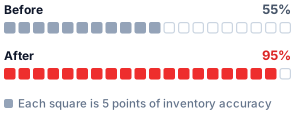
- 55% to 95%inventory accuracy
- 20%+rise in customer satisfaction
Seasonal retailer
- 60 3PL facilities
Starting point
A seasonal, high-velocity 3PL network with fragmented data exchanges and little real-time visibility into carton and pallet movements.
What Everest did
Built a custom WMS for that model.
Results
- End-to-end visibility across all 60 sites
- Less manual reconciliation of pallets and cartons
- Consistent data at every site, online or offline
Read the full case study.
Source: Everest Technologies, Supply Chain and Case Studies.
Where Everest Can Help
- 300+WMS go-lives delivered by Everest Technologies since 1997
- 150+go-lives on Manhattan Active®, 65 of them in 2024 and 2025 alone
- PlatinumManhattan Associates Partner and two-time Partner of the Year (Commerce Services, 2022; Collaboration Excellence, 2023)
- SilverInfios (Körber) Partner
Where Everest fits in the sequence
- Assess and plan Assessment visits and Phase Zero. Fix 1
- Configure and extend Certified teams, with 100+ custom extensions delivered. Fix 4
- Connect Integration, Data & Analytics. Fix 5
- Test Quality Engineering. Fix 6
- Support Managed services across the platforms above. Fix 7
- Take over Everest regularly stabilizes live environments implemented by other partners. Live systems
If your WMS is underperforming its benchmarks, Everest's supply chain consultants can walk through whether to tune, extend, or modernize it.
Frequently Asked Questions
To improve a WMS, work in this order: baseline performance against published benchmarks, clean item and inventory data, re-slot inventory and rebalance labor, replace custom code with configuration or update-safe extensions, connect systems through a reusable integration layer, test for peak volume and every release, and put managed support behind the live system.
WMS optimization is improving how an existing warehouse management system performs through better data, configuration, integration, testing, and support, without replacing the platform.
Optimize first when the vendor still supports your version and the gaps sit in data, configuration, slotting, or integrations. Consider replacing or modernizing when the platform cannot connect to planned automation or new sites, or when your version is nearing end of support. Heavy core customization usually calls for optimization first, then a reassessment. This is Everest's working view, not an industry standard.
WERC's 2025 DC Measures Report tracks more than 30 metrics. Useful starting points are on-time shipments (best-in-class 99.5% or higher), order-picking accuracy by order (99.68% or higher), average warehouse capacity used (90% or higher), and peak warehouse capacity used (100% or higher). Also track dock-to-stock cycle time and inventory count accuracy by location.
On earlier on-premise platforms such as Manhattan SCALE and WMOS, extensions are typically customizations to the core that must be retested and reapplied at each upgrade. Manhattan Active® is built so version updates apply without re-implementation, though extensions should still be regression-tested each quarterly release. (Everest Technologies)
Test the full workload at once: functional, integration, end-to-end, user acceptance, and performance testing, including load testing for peak volumes and warehouse automation. Automated regression frameworks let each release be checked the same way. (Everest Technologies)
Everest's support for Manhattan Active® environments includes SLA-backed L2 and L3 application support, production monitoring, incident and release management, and continuous optimization, with 24/7 post-production coverage. Everest also supports Manhattan SCALE, WMOS, Infios, and Made4Net.
Sources
- Descartes Systems Group, "Descartes' Study Reveals 76% of Supply Chain and Logistics Operations are Experiencing Notable Workforce Shortages," January 30, 2024 (1,000 decision-makers surveyed in late 2023 across nine European countries, Canada, and the U.S.). https://www.descartes.com/resources/news/descartes-study-reveals-76-supply-chain-and-logistics-operations-are-experiencing
- WERC (Warehousing Education and Research Council), "2025 DC Measures Report," released June 5, 2025, the source of the best-in-class figures in this article. Report: https://werc.org/page/ASSESS-DC_Measures. Online Benchmarking Tool: https://werc.org/page/ASSESS-Online_Benchmarking_Tool
- Yale Materials Handling, "Top 12 distribution center metrics," a public summary of the best-in-class scores from the 2025 WERC DC Measures Report. https://www.yale.com/globalassets/coms/yale/north-america/documents/white-papers/snack-drawer/YALE-1520_WERC-DC-Metrics-infographic.pdf
- Gartner, "Gartner Predicts Half of New Warehouses Built in Developed Markets Will Be Human-Optional Facilities by 2030," April 13, 2026. https://www.gartner.com/en/newsroom/2026-04-13-gartner-predicts-half-of-new-warehouses-built-in-developed-markets-will-be-human-optional-facilities-by-2030
- Everest Technologies, "Manhattan Active® Implementation Partner" (partner status, go-live counts, support scope). https://everesttech.com/manhattan
- Everest Technologies, "Supply Chain & WMS Implementation" (methodology, testing, integration, case study results). https://everesttech.com/services/supply-chain
About the Author