Why Your Enterprise Data Isn't Delivering, and What to Do About It
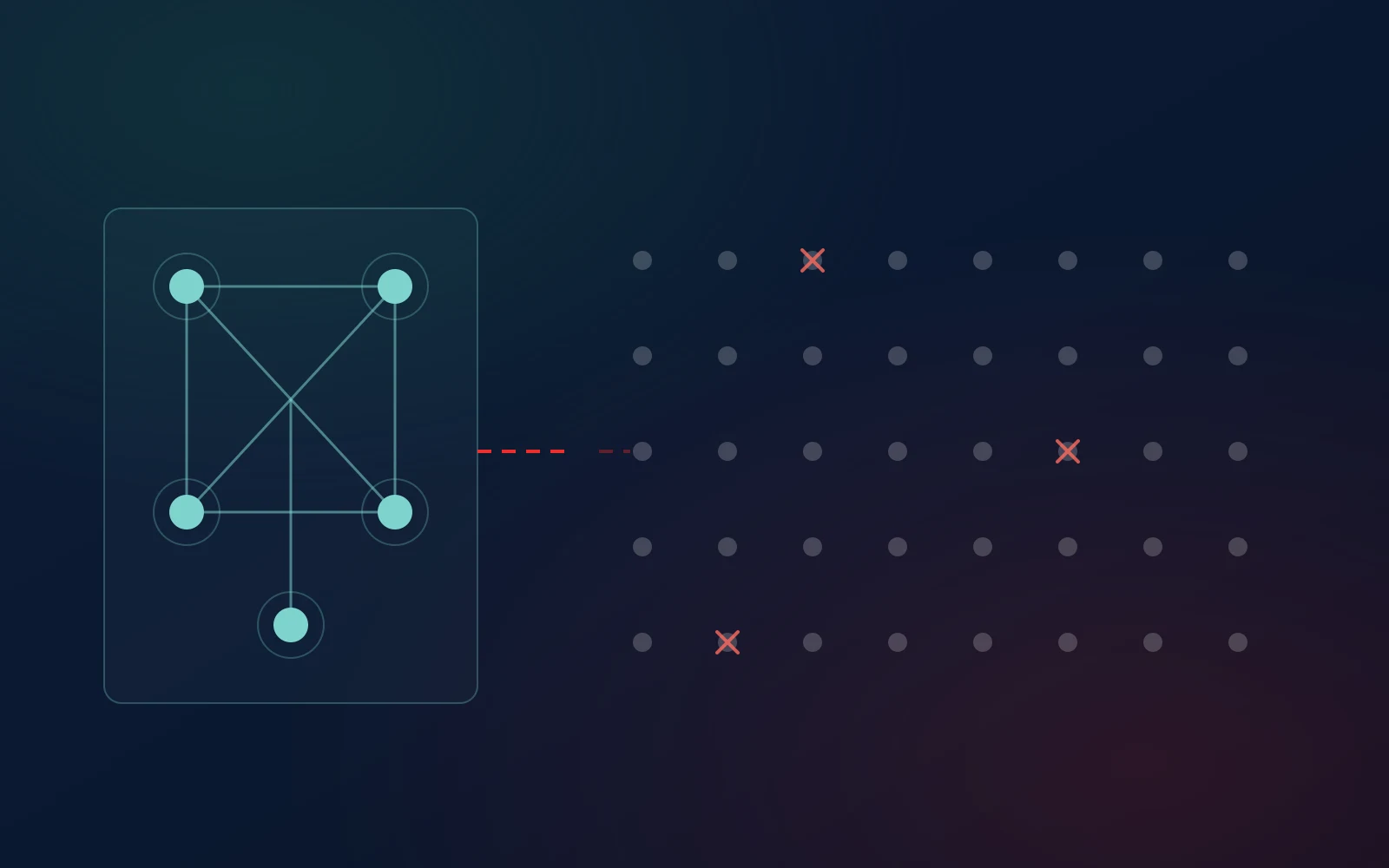
Quick answer. Most enterprises do not have a data shortage. They have a data assembly problem: hundreds of applications holding partial views, and no governed layer that turns those views into one number anyone will act on.
At a Glance
- Only 28% of the 897 applications running in the average large enterprise are actually integrated.
- 95% of IT leaders say integration gaps are holding back their AI initiatives.
- Poor data quality costs the average organization $12.9 million a year.
- That translates into 15 to 25% of annual revenue lost to bad data.
- Formal governance more than doubles the odds of an organization trusting its own data.
- Strong integration nearly triples analytics ROI: 10.3x versus 3.7x for poorly connected organizations.
Three root causes sit behind those numbers: integration, governance, and an architecture decision that gets made before anyone has agreed what it is for.
Enterprise data is everywhere and rarely usable. That is not a contradiction. It is what happens when systems accumulate faster than the connections between them, and when nobody is accountable for what a given field actually means.
No AI model, no dashboard, and no executive review can compensate for that gap on its own. A model reasons from what it can reach. If most of the estate is unreachable, the model is confidently describing a fraction of the business.
This article covers three root causes and one practical starting point: the integration problem, the governance problem, and the warehouse versus lake architecture question.
The Integration Problem
Every enterprise has more systems than it has connections between them. That gap is where most of the damage happens.
- 897 applications, 28% integrated. The rest need manual intervention, custom scripts, or someone copying numbers between screens.
- Every manual step is a place where data drifts, breaks, or stops updating.
- 95% of IT leaders say integration challenges are impeding their AI implementation.
95% of IT leaders say integration challenges are impeding their AI implementation.
MuleSoft, Connectivity Benchmark Report 2025
An AI model is only as good as the data it can see right now. Disconnected systems mean the model reasons from a stale or partial picture, no matter how advanced the model itself is.
Data silos are not a secondary concern either. 68% of data practitioners cite them as their top concern, a figure up 7% year over year in DATAVERSITY's Trends in Data Management 2025.
Where Everest fits
Point to point integration is exactly how enterprises end up with 897 disconnected applications in the first place. Everest's Integration, Data and Analytics practice builds reusable connections on modern iPaaS and event streaming platforms, including MuleSoft, Boomi, and Kafka, so new systems attach to existing infrastructure instead of triggering a fresh custom build each time.
The Governance Problem
Integration gets the data moving. Governance determines whether anyone can trust it once it arrives.
- 47% of newly created data records contain at least one critical error. That is data created today, not just legacy records.
- Poor data quality costs the average organization $12.9 million per year.
- Companies lose 15 to 25% of revenue annually to poor data quality.
71% of organizations with formal governance report high data trust, against 50% without it.
Precisely and Drexel University LeBow College of Business, 2026 State of Data Integrity and AI Readiness
This is showing up at the top of the organization, not just inside data teams:
- 43% of chief operations officers identified data quality as their most significant data priority, in the IBM Institute for Business Value 2025 CDO Study.
- 43% of data leaders cite data readiness as their most significant barrier to AI alignment.
- Only 31% of organizations have AI metrics tied directly to business KPIs.
Without governance and outcome linked metrics, AI investment becomes activity without accountability. The spend is visible. The result is not.
Where Everest fits
Governance is not a policy document. It has to be enforced in how systems are tested and released. Everest's Quality Engineering practice builds automated validation and data quality checks directly into retail and supply chain systems, so errors are caught before they compound downstream rather than discovered after the fact.
The Warehouse Versus Lake Question
Before any of this scales, enterprises have to decide where data lives and in what shape. This gets treated as a technology preference. It is really an operating decision.
| Factor | Data warehouse | Data lake |
|---|---|---|
| Data type | Structured, processed | Structured, semi-structured and unstructured, raw |
| Schema | Schema on write, defined before loading | Schema on read, defined at query time |
| Best suited for | Business reporting, BI dashboards, defined KPIs | Data science, machine learning, exploratory analysis |
| Governance requirement | Enforced upfront, at ingestion | Enforced downstream, at consumption |
- A lake without governance becomes exactly the kind of sprawl that produces the 47% error rate cited above.
- A warehouse without integration upstream is a well organized repository of incomplete data.
Organizations with strong data integration achieve 10.3x ROI from analytics investments, against 3.7x for poorly connected organizations.
IDC, 2024 AI Opportunity Study
Where Everest fits
Many enterprises need both, a warehouse for governed reporting and a lake for exploratory AI work. Everest's data engineering practice helps design that split around actual use cases rather than defaults, and connects both to the same governed integration layer so neither becomes an island of its own.
Where to Start
This does not get solved with a single initiative. It gets solved in sequence.
Audit integration coverage before adding new tools
Find out what share of the current application estate is actually integrated. Most leaders are surprised by how low that number is once someone counts it, and the count itself usually changes the conversation more than any vendor demo.
Name data owners before naming a platform
Governance fails most often not from missing technology, but because nobody is accountable for what a data field means or who is allowed to change its definition.
Decide the warehouse and lake split by use case
Match structured reporting to a warehouse. Match exploratory AI and machine learning work to a lake. Deciding by platform preference instead of by use case is how organizations end up paying for both and trusting neither.
Build validation into the release process
Data quality checks that run on a periodic audit cycle catch problems long after they have already cost revenue. Checks built into every release catch them before they spread.
How Everest Technologies Helps
Everything above describes a structural problem: applications that do not talk to each other, governance that exists on paper but not in practice, and architecture decisions made before the use case was clear. Fixing it does not start with a platform purchase. It starts with an honest inventory of where the fragmentation actually lives.
Everest's Integration, Data and Analytics practice builds the connective layer most enterprises are missing, using MuleSoft, Boomi, and Kafka to replace one off, point to point integrations with reusable connections that new systems can plug into. That is the difference between the 28% of applications integrated today and an architecture where the next system does not require another custom build.
Everest's Quality Engineering practice puts governance into practice rather than policy, building automated data quality and validation checks directly into system releases, so errors are caught before they compound downstream instead of being discovered in a later audit.
For organizations still working out the warehouse versus lake question, Everest's data engineering team helps design that split around real business use cases, not platform defaults, and connects both to the same governed integration layer so neither becomes another silo.
Ready to find out where your own fragmentation is costing the most?
We help enterprises map what is actually connected, who owns which definitions, and where the reconciliation work is quietly absorbing effort. Happy to compare notes on your data landscape.
Let's talkSources
- MuleSoft. Connectivity Benchmark Report 2025.
- Gartner. Cost of poor data quality.
- MIT Sloan Management Review / Thomas C. Redman, Cork University Business School.
- DATAVERSITY. Trends in Data Management 2025.
- Precisely and Drexel University LeBow College of Business. 2026 State of Data Integrity and AI Readiness. Survey of 505 senior leaders, fielded in the second half of 2025.
- IBM Institute for Business Value. 2025 CDO Study.
- IDC. 2024 AI Opportunity Study.